The Participation Myth: More Discussion Is Not Always Better
The participation myth mistakes frequent discussion for inclusion. Use focused prompts and quiet thinking time to give rural adult learners more ways to contribute.

When a trainer asks, “Any thoughts?” and the same two people answer, the room may look engaged while others stay silent. The participation myth is that more open discussion automatically includes everyone. In rural adult learning, specific prompts and a pause to think can make it easier to contribute without putting anyone on the spot.
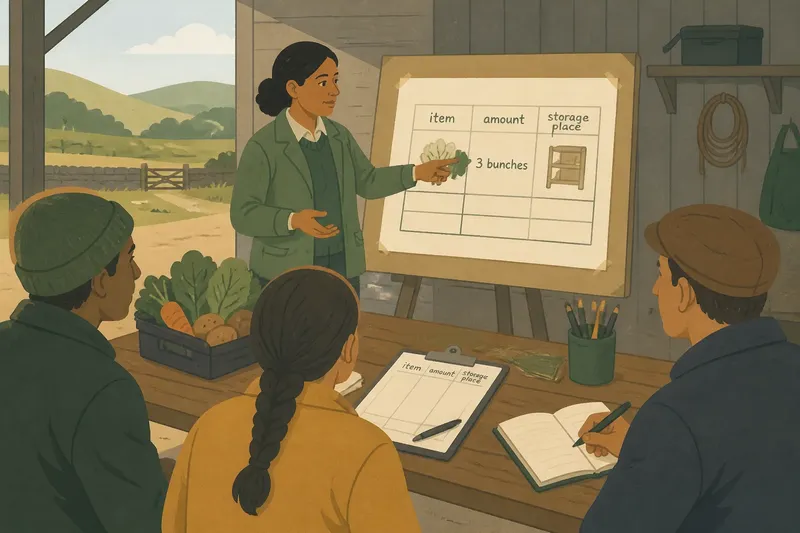
Consider an invented, hypothetical session at a village hall. A trainer is helping a mixed group of adults practise sorting local produce for a shared collection. Some participants are confident speakers; others prefer to watch first, speak in a smaller group or explain their reasoning after they have had time to think. The trainer’s task is not to extract a comment from each person. It is to make useful contributions possible in more than one way.
The open question stalls
At the start, the trainer holds up a crate containing several kinds of produce and asks, “How should we sort this?” The question is broad, and it comes before the group has handled the materials. Two participants offer quick answers. A few others glance at the crate, but no one joins in. The trainer fills the silence with another question, then another.
Nothing is wrong with the quieter participants. The prompt asks them to invent a complete answer in public, with no time to inspect the produce or hear what others mean by sorting. People may also have different assumptions about the task. One person is thinking about ripeness, another about destination, and someone else about keeping damaged items separate. An open invitation can hide those differences rather than bring them into the discussion.
The trainer notices that repeating the question is not changing who speaks. Instead of treating silence as a problem to overcome, the trainer changes the conditions for answering. The crate remains available, but the next prompt names one decision at a time.
Quiet time changes the task
The trainer asks everyone to look through the crate and decide which item they would sort first, and why. Participants get a short, quiet pause to think. They can point to an item, make a note on scrap paper, or simply prepare a sentence. No one is asked to explain before they are ready.
This pause is not empty time. It lets participants inspect the materials and form an answer without competing for the floor. It also gives the trainer a chance to see where attention is going. Several people focus on bruised produce; others look at labels or the intended destination. Those observations give the next conversation something concrete to work with.
Then the trainer invites participants to compare their choices with a nearby partner. The pair has a clear task: identify one reason for sorting an item separately. A person who does not want to speak can point, write a few words, or ask their partner to share the pair’s idea. These options are invitations, not a requirement to disclose why someone is quiet.
Specific prompts widen entry
After the pair discussion, the trainer asks, “Which item did you separate, and what did you notice?” This is narrower than “What do you think?” It asks for an observation before asking for a judgement, so participants can begin with something visible. The trainer leaves a pause after asking and does not immediately call on the quickest speaker.
One participant points to a bruised item and says it should be set aside. Another explains that the group should check whether it is still suitable for a different use. Someone else adds that the collection label may matter more than appearance. The discussion now has several distinct contributions because the prompt makes room for noticing, explaining and weighing options.
The trainer does not treat every comment as a vote or try to settle the decision by counting voices. Instead, they ask what information the group needs before sorting. Participants identify the label and the collection’s acceptance rules. The trainer checks those instructions before continuing, since local requirements can differ. The group can now separate what it has observed from what it still needs to confirm.
Participation questions that matter?
Does every learner need to speak?
No. Speaking aloud is one form of contribution, not the only evidence that someone is following. A person may point to a detail, make a note, listen closely or contribute through a partner; offer options without insisting that a quiet learner explain themselves.
How long should quiet thinking time last?
Allow enough time for people to inspect the task and form an answer, then continue when the room seems ready. If participants are still looking, writing or considering the choices, rushing to fill the silence can take away the very thinking time the prompt was meant to provide.
What if nobody answers a focused prompt?
Make the response easier to begin: ask for a point, a choice between two visible options, or one thing someone noticed. You can also let people compare answers in pairs before inviting a few observations to the whole group.
How can a trainer avoid hearing only confident voices?
Vary how contributions enter the room. Give thinking time, use pair conversation, invite written or pointed responses, and leave space before taking another comment; do not assume that the fastest answer represents the group.
Read the room differently
In the invented session, the change is observable: the group moves from two quick replies to several kinds of useful input, and its members identify what needs checking before acting. That does not mean every learner has suddenly become equally comfortable speaking. It means the trainer has stopped treating public talk as the only sign of participation.
For your next session, notice who gets the first turn and what the question asks people to do. Replace a broad invitation with one concrete prompt, build in quiet thinking time, and offer a lower-pressure route such as a pair exchange or a written note. Then listen for the content of contributions, not merely how often each person speaks. More discussion is helpful only when it gives people a workable way into the learning.