A Five-Minute Review After the Room Clears
Use a five-minute post-session review to record what shaped the room, spot a practical snag and decide what to carry into your next rural training session.
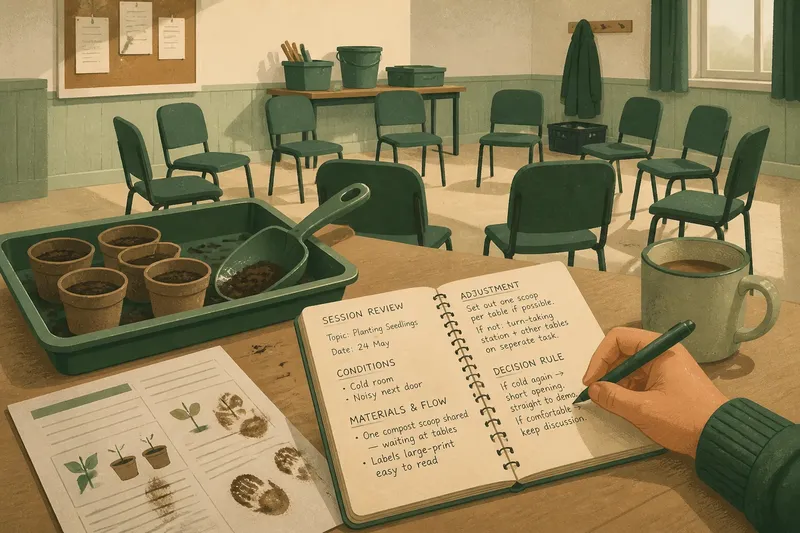
The last learner has left the village hall, but the room still holds clues: a half-used tray of seed pots, a handout with muddy fingerprints and chairs pulled into a close circle. A five-minute post-session review helps you record what shaped the session and decide what to carry into the next one.
Keep the note focused on the conditions and materials around the learning, rather than rating your teaching or judging learners. Use a pocket notebook, the back of your printed session plan or an offline notes app. Avoid names and sensitive details; follow your organisation’s privacy practice if you record feedback.
Capture the setting
Write the session topic, date and one condition that affected the room. Note details that may matter when you prepare again: shared tools, a cold space, late transport arrivals, a noisy adjoining room or materials that were difficult to see.
Keep observation separate from explanation. “Two groups shared the seed trays” describes what happened. “Sharing the trays slowed the activity” is a possible explanation. If you are unsure, mark it as uncertain rather than turning it into a firm account.
Notice materials and flow
Record which materials were ready, missing, awkward to share or useful in a different way than planned. Name the item and the point where it mattered. “The large-print plant labels were easy to read from the back row” is more useful for preparation than “materials worked well”.
Then note a practical moment in the session’s flow: a delay while tools were passed around, a break that came at a useful point, or a discussion that needed a quieter corner. Stick to what you could see or hear, without claiming that one detail explains everyone’s experience.
Say you are preparing a village-hall session about planting seedlings. The group shares one compost scoop, and learners wait while it moves between tables. You note the shared scoop and the waiting; for the next session, you set out one scoop per table if supplies allow. If they do not, you could arrange a turn-taking station and keep the other tables on a separate task while they wait.
Choose a workable adjustment
Pick one change that fits the resources and setting you expect next time. Make the action specific enough to prepare for: put picture cards beside the written instructions, set out a tray for muddy tools, or move the demonstration where everyone can see it.
Add a simple decision rule so the note helps you adapt. For example: if the room is cold again, keep the opening activity short and move straight to the indoor demonstration; if it is comfortable, keep the planned discussion. The point is to make a practical choice, not to promise a particular outcome.
Use a decision checklist
Before leaving, scan the room and your session plan. For each observation, decide what to keep, change or prepare differently; if the condition may not recur, keep the note but avoid redesigning the whole session around it.
- Tools: Check whether each activity had the tools it needed. If learners had to wait for a shared item, then prepare more sets if available; otherwise, plan a turn-taking station.
- Printed materials: Check whether instructions and labels were easy to read in the room. If text was hard to see, then use larger print or picture cards; if it was clear, keep the format.
- Room layout: Check whether everyone could see the demonstration area. If sightlines were blocked, then move chairs or the demonstration table; if everyone had a clear view, keep the arrangement.
- Noise: Check whether another activity or the room itself made conversation difficult. If speech was hard to hear, then choose a quieter corner or pause for discussion; if not, retain the current space.
- Arrival conditions: Check whether late arrivals disrupted the opening. If they missed essential directions, then prepare a short recap card; if they could join without difficulty, keep the opening plan.
- Clean-up: Check whether packing away left materials mixed or hard to find. If it did, then label containers or set out a sorting tray; if items were easy to return, keep the current system.
Questions about the review?
What should I write if I am unsure why something happened?
Record the visible detail and mark the cause as uncertain. For instance, note that the demonstration paused while people moved closer, rather than deciding that the instructions were unclear.
What if a planned material was missing?
Write down what was unavailable and what substitute, if any, you used. Before the next session, decide whether to source the original item, prepare a suitable alternative or adjust the activity.
How should I handle learner feedback?
Keep feedback distinct from your own observations and follow your organisation’s approach to consent and privacy. A brief comment can inform preparation, but do not present one person’s view as the whole group’s.
When should I reread the note?
Look at it while preparing the next session, when you can check which conditions still apply. Keep, adapt or set aside the suggested change according to the room, materials and group you expect.
Store it for next time
Put the note with the session plan, in a clearly named offline file or inside the folder that holds the teaching materials. Use plain words you will recognise later, and leave out private learner details.
A five-minute post-session review is most useful when it helps you prepare for the setting you are likely to meet, without treating one day as a rule for every group. If you cannot tell whether a snag came from the room, the materials or the timing, preserve that uncertainty and make the next preparation flexible enough to respond.